Overview
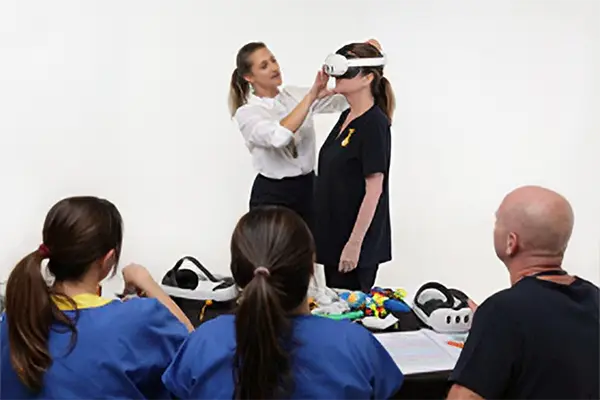
This innovative full-day workshop introduces a cutting-edge approach to managing aggression and violence in healthcare through Trauma-Informed De-escalation Education (TIDE). Developed and delivered by experienced clinician and educator Misty Carey, the program combines evidence-based theory with immersive virtual reality and AI-driven simulations. Participants will explore the principles of trauma-informed care, including recognising early signs of escalation, understanding the stress response, and applying structured approaches to de-escalation in high-risk situations.
Through a combination of interactive teaching, small group work, and individual VR experiences, participants will observe realistic Code Black scenarios and practise de-escalation techniques in a safe, controlled environment using AI avatars. The workshop also addresses risk assessment, communication strategies, and organisational responses to violence, with a strong emphasis on cultural safety and real-world application. This session offers a unique opportunity to build confidence and capability in managing some of the most challenging interactions in emergency care.
Lead Facilitator
Misty Carey, Nurse, Educator and Founder of TIDE
Who Should Attend
FACEMs, Trainees, and healthcare professionals seeking to enhance their skills in de-escalation, communication, and workplace safety.
Limited places available!
ACEM CPD Hours
Educational Activities (EA): 5 hours 30 minutes
Reviewing Performance (RP): 2 hours 30 minutes
Health Outcomes: Professionalism, Addressing Health Inequities, Ethical Practice
Agenda
| Time | Topic/Activity | Presenter/Facilitator |
| 0900-0930 | Welcome Hierarchy of controls Psychological safety & wellbeing Learning outcomes | Misty Carey RN/Cert IV TAA Brett Sutton, Security manager/Cert IV TAA |
| 0930-1000 | VR: Survival brain vs Cognitive brain Activity: Critical thinking: setting up for success | Misty Carey, Brett Sutton |
| 1000-1030 | Trauma Trauma tree/ types of trauma ACES: Adverse childhood events Impact on brain development Social determinants of health | Misty Carey, Brett Sutton |
| 1030 – 1100 | Morning Tea | |
| 1100-1130 | Trauma & stress response Nervous system Signs and symptoms Window of Tolerance Activity: Personal experiences | Misty Carey |
| 1130-1200 | Trauma-Informed Care (TIC) Knowledge and practice Six guiding principles 4 R’s Ladder of inference | Misty Carey |
| 1200-1230 | Group Activities 1) VR: Code Black 2) Activity: ACEs teach back 3) Watch & discuss: ACE’s TED talk | Misty Carey, Brett Sutton, |
| 1230-1330 | Lunch | |
| 1330-1400 | Escalation Iceberg: warning signs & causes Stress model of crisis Calming the agitated patient Physical safety/defence techniques | Brett Sutton |
| 1400-1430 | De-escalation skills with a trauma-informed lens Applying the six guiding principles for TIC | Brett Sutton |
| 1430-1500 | Group Activities: 1) AI: “Difficult conversations” De-escalate a frustrated AI client 2) Activity: Enacting the Mental Health Act 3) Listen & comment: “When hospitals become hostile” | Misty Carey, Brett Sutton |
| 1500-1530 | Afternoon Tea | |
| 1530-1600 | Group discussion Facilitated reflective practice 1) Share thoughts on activities and learnings | Misty Carey, Brett Sutton |
| 1600-1700 | Where to from here? Implementation and Quality Improvement Review “Critical thinking: setting up for success” Deep dive into trauma-informed care Organisational training and internal champions Becoming a Trauma-Informed Organisation Evaluation | Misty Carey, Brett Sutton |